A reflection on Detective Miriam Virgo’s extraordinary scrutiny experiences by Alton P Bell
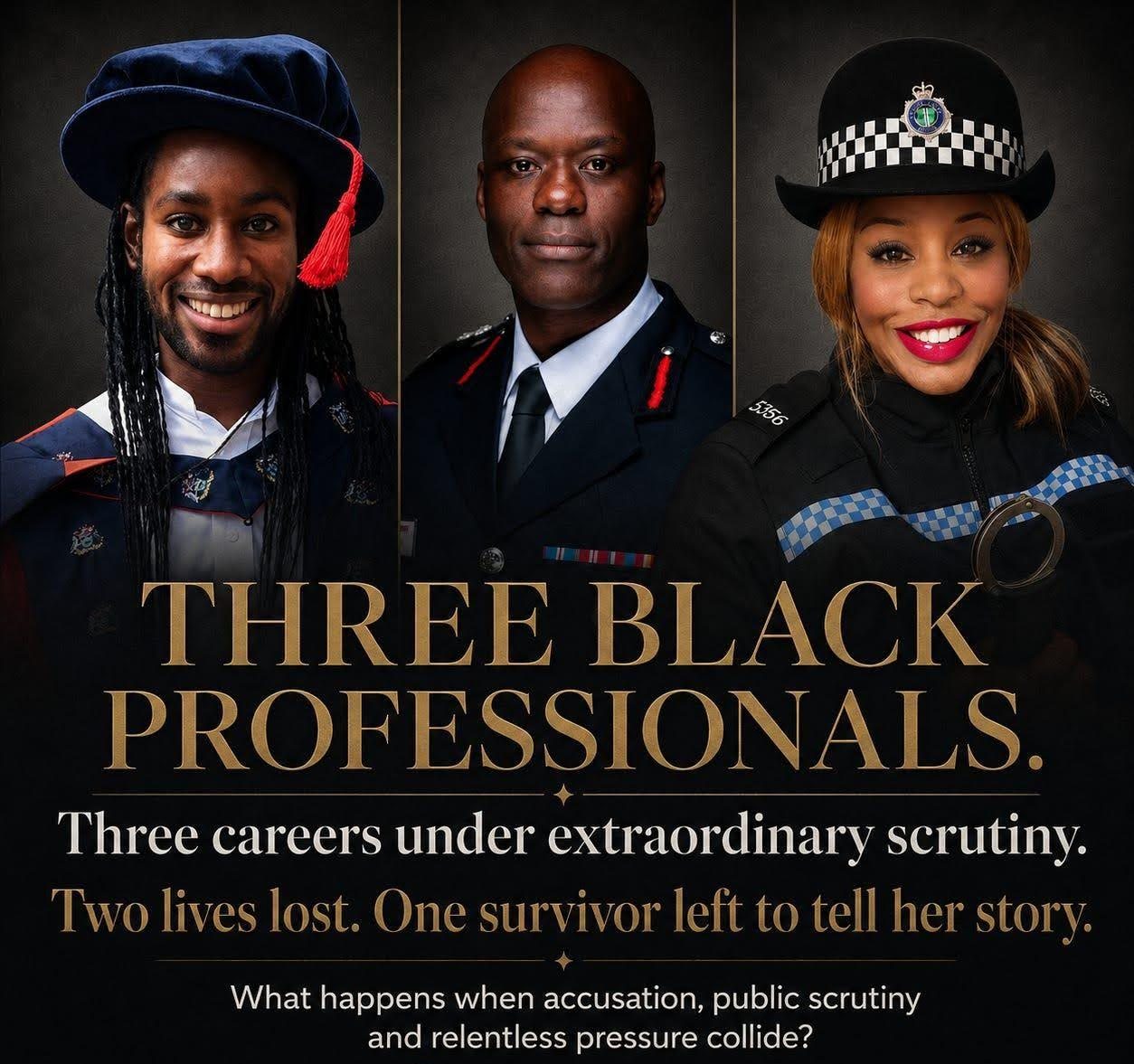
Following the tragic deaths of Chief Fire Officer Wayne Brown in January 2024 and Professor Jason Arday on 14th August 2026, Detective Miriam Virgo reluctantly decided to tell her story.
Miriam Virgo’s deeply personal account, The Detective in the Dock, is an attempt to reclaim her identity from the headlines that have defined her in recent years. Prompted by the death of Professor Jason Arday, Virgo reflects on the psychological consequences of public scrutiny and asks a central question: what happens to the human being at the centre of a headline after everyone else has moved on? She makes clear that she did not know Arday and does not speculate about his death, but says the news reminded her of her own experience of allegations, judgement and public humiliation.
Virgo reveals that the pressure surrounding her own case contributed to a severe deterioration in her mental health and that she attempted to take her own life, spending three days in intensive care. Her article is therefore not simply a defence of her actions, but an argument that accountability should not erase a person’s humanity. She acknowledges making mistakes and says she is not asking readers to disregard her conviction, which she is currently appealing. Instead, she wants the public to understand the life and circumstances behind the headlines.
That story begins long before Virgo became a police officer. She describes experiencing sexual violence as a child, teenager and young woman, including being drugged, raped and becoming pregnant. When she reported abuse as a teenager, she says the response she received left her feeling unsupported and partly responsible for what followed. Those experiences, she explains, created lasting trauma but also inspired her career choice. At nineteen, she joined the police determined to become the kind of officer she herself had needed as a victim.
Virgo went on to serve for more than two decades. As a Black woman in policing, she recalls racist comments, mockery of Jamaican accents and suggestions that her achievements were attributable to her race. Nevertheless, she progressed to become a detective. Compassion, she says, remained central to her identity and motivated extensive charitable work. She founded The Naked Truth Ministry to support women who had experienced abuse and created the Black and Blue Project to improve relationships between police and Black communities. She also supported homeless people, widows, orphans and schoolchildren.
Her personal life, however, became increasingly difficult. After another sexual assault, Virgo says she stepped away from policing while receiving treatment for PTSD. She later returned, but suffered a devastating succession of bereavements, including the deaths of her mother and brother. In total, she says she experienced seventeen bereavements. Her mental health deteriorated severely, leaving her depressed, traumatised and vulnerable.
Shortly after her brother’s death, Virgo met a man who became central to the events leading to her criminal case. She describes feeling deceived and betrayed and admits that, while grieving and psychologically unwell, she lost her temper and said things she regrets. Some of these distressed interactions, she says, were secretly recorded. She was subsequently arrested over allegations that included offensive messages. Virgo maintains that her phone was not in her possession when some messages were sent and raises concerns about evidence she believes could have assisted her defence.
Virgo also describes what she considers serious problems during the legal process, including incorrect criminal information relating to a potential defence witness. A jury ultimately acquitted her of the more serious allegation before it, after requesting additional evidence relating to the security of her phone. A lesser harassment allegation was subsequently pursued, however, and she was convicted of basic harassment. She is appealing that conviction and stresses that the unresolved legal questions should be determined by the courts.
A major theme of the article is Virgo’s belief that her psychological condition was insufficiently understood. She reports diagnoses including PTSD, Complex PTSD, Emotionally Unstable Personality Disorder and Major Depressive Disorder. She does not present mental illness as an excuse for her behaviour but argues that it provides essential context when judging someone’s actions and state of mind. She also questions how she was treated after her suicide attempt, saying she was interviewed by police without the medical assessment she would have expected for a vulnerable detainee.
Virgo is particularly critical of media coverage. She says descriptions such as “gangster cop” reduced decades of policing and charitable work to a damaging caricature. Journalists came to her home and questioned neighbours, while photographs taken shortly after she had left hospital became part of her public image. She argues that online journalism makes this especially damaging because sensational headlines remain searchable long after a case stops being current news.
Yet Virgo does not reject journalism, open justice or accountability. Her argument is that these principles should coexist with humanity. A person can be investigated, prosecuted or criticised, she says, without having their entire identity reduced to their worst moment. The effects of public humiliation also extend beyond the individual to children, parents and other family members.
Ultimately, the article is Virgo’s attempt to take ownership of her narrative. She identifies herself simultaneously as a former detective, survivor of sexual violence and racism, charity worker, grieving daughter and sister, mother, person with serious mental-health difficulties, convicted defendant and survivor of a suicide attempt. No single one of those descriptions, she argues, adequately defines her. She accepts that some readers may continue to judge her and that her appeal must be decided through the legal process. But she refuses to allow headlines alone to determine how her life is remembered.
Her final message is that accountability and compassion are not incompatible. Behind every allegation, photograph and headline remains a human being with a history, relationships and struggles that the public may never see. After years of believing silence would protect her, Virgo concludes that reclaiming her own voice is now part of rebuilding her life.
Her complete article can be found here – detective in the dock.